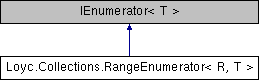
Helper struct: enumerates through a forward range (IFRange{T}), calling the range methods through R instead of through IFRange{T}.
More...
Source file:
Helper struct: enumerates through a forward range (IFRange{T}), calling the range methods through R instead of through IFRange{T}.
- Type Constraints
-
| R | : | IFRange<T> | |
| R | : | ICloneable<R> | |
|
|
T | Current [get] |
| |
object
System.Collections.IEnumerator. | Current [get] |
| |
|
|
| RangeEnumerator (R range) |
| |
|
bool | MoveNext () |
| |
|
void IDisposable. | Dispose () |
| |
void
System.Collections.IEnumerator. | Reset () |
| |
|
| static R_ | R_Clone< R_ > (R_ r) |
| | Since R implements IFRange{T} which includes ICloneable{IFRange{T}}, we cannot invoke ICloneable{R}.Clone because the compiler complains that Clone() is ambiguous. I used to think it was necessary to cast the range to ICloneable{R} just to clone it; if R is a value type then it is boxed, hurting performance. But then I thought of doing this. More...
|
| |
| static R_ Loyc.Collections.RangeEnumerator< R, T >.R_Clone< R_ > |
( |
R_ |
r | ) |
|
|
static |
Since R implements IFRange{T} which includes ICloneable{IFRange{T}}, we cannot invoke ICloneable{R}.Clone because the compiler complains that Clone() is ambiguous. I used to think it was necessary to cast the range to ICloneable{R} just to clone it; if R is a value type then it is boxed, hurting performance. But then I thought of doing this.
- Type Constraints
-
| R_ | : | ICloneable<R_> | |
| R_ | : | r.Clone() | |
 1.8.7
1.8.7

