|
Enhanced C#
Loyc library documentation
|
|
Enhanced C#
Loyc library documentation
|
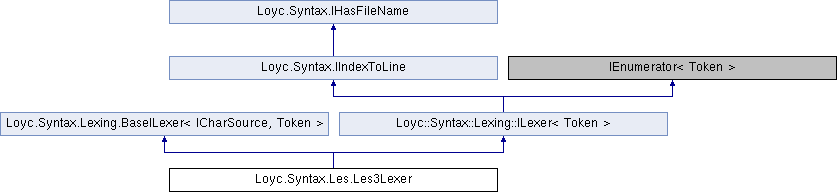
Properties | |
| bool | PreferCustomLiterals [get, set] |
| If this flag is true, all literals except plain strings and true/false/null are stored as CustomLiteral, bypassing number parsing so that all original characters are preserved if the output is written back to text. More... | |
 Properties inherited from Loyc.Syntax.Lexing.ILexer< Token > Properties inherited from Loyc.Syntax.Lexing.ILexer< Token > | |
| ISourceFile | SourceFile [get] |
| The file being lexed. More... | |
| IMessageSink | ErrorSink [get, set] |
| Event handler for errors. More... | |
| int | IndentLevel [get] |
| Indentation level of the current line. This is updated after scanning the first whitespaces on a new line, and may be reset to zero when NextToken() returns a newline. More... | |
| UString | IndentString [get] |
| Gets a string slice that holds the spaces or tabs that were used to indent the current line. More... | |
| int | LineNumber [get] |
| Current line number (1 for the first line). More... | |
| int | InputPosition [get] |
| Current input position (an index into SourceFile.Text). More... | |
| Properties inherited from Loyc.Syntax.IFileName | |
| string | FileName [get] |
Public Member Functions | |
| Les3Lexer (string text, string fileName="") | |
| Les3Lexer (ICharSource text, string fileName, IMessageSink sink, int startPosition=0) | |
| override Maybe< Token > | NextToken () |
| Scans the next token and returns information about it. More... | |
| bool | TDQStringLine () |
| bool | TSQStringLine () |
| bool | MLCommentLine (ref int nested) |
| Public Member Functions inherited from Loyc.Syntax.IIndexToLine | |
| ILineColumnFile | IndexToLine (int index) |
| Returns the position in a source file of the specified index. More... | |
Static Public Member Functions | |
| static object | ParseLiteral (Symbol typeMarker, UString unescapedText, out string?syntaxError) |
| static string | UnescapeQuotedString (ref UString sourceText, Action< int, string > onError, UString indentation=default(UString), bool allowExtraIndent=false, bool parseAsBytes=true) |
| Parses a normal or triple-quoted string that still includes the quotes. Supports quote types '\'', '"' and '`'. More... | |
| static void | UnescapeQuotedString (ref UString sourceText, Action< int, string > onError, StringBuilder sb, UString indentation=default(UString), bool allowExtraIndent=false, bool parseAsBytes=true) |
| Parses a normal or triple-quoted string that still includes the quotes (see documentation of the first overload) into a StringBuilder. More... | |
| static bool | UnescapeString (ref UString sourceText, char quoteType, bool isTripleQuoted, Action< int, string > onError, StringBuilder sb, UString indentation=default(UString), bool allowExtraIndent=false, bool parseAsBytes=true) |
| Parses a normal or triple-quoted string whose starting quotes have been stripped out. If triple-quote parsing was requested, stops parsing at three quote marks; otherwise, stops parsing at a single end-quote or newline. More... | |
| static TokenType | GetOperatorTokenType (UString op) |
Under the assumption that op is a sequence of punctuation marks that forms a legal operator, this method decides its TokenType. More... | |
Protected Member Functions | |
| UString | Text () |
| UString | Text (int startPosition) |
| sealed override void | AfterNewline () |
| override bool | SupportDotIndents () |
| UString | GetUnescapedString (bool hasEscapes, bool isTripleQuoted) |
| UString | UnescapeSQStringValue (bool hasBackslash) |
| Symbol | ParseOp (out TokenType type) |
Protected fields | |
| TokenType | _type |
| NodeStyle | _style |
| int | _startPosition |
| UString | _textValue |
|
Dictionary< Pair< UString, bool >, Symbol > | _typeMarkers = new Dictionary<Pair<UString, bool>, Symbol>() |
|
Dictionary< UString, Pair < Symbol, TokenType > > | _opCache = new Dictionary<UString, Pair<Symbol, TokenType>>() |
|
inlinestatic |
Under the assumption that op is a sequence of punctuation marks that forms a legal operator, this method decides its TokenType.
Scans the next token and returns information about it.
Implements Loyc.Syntax.Lexing.ILexer< Token >.
References Loyc.Newline, Loyc.Syntax.Operator, and Loyc.Syntax.Lexing.Spaces.
|
inlinestatic |
Parses a normal or triple-quoted string that still includes the quotes. Supports quote types '\'', '"' and '`'.
| sourceText | input text |
| onError | Called in case of parsing error (unknown escape sequence or missing end quotes) |
| indentation | Inside a triple-quoted string, any text following a newline is ignored as long as it matches this string. For example, if the text following a newline is "\t\t Foo" and this string is "\t\t\t", the tabs are ignored and " Foo" is kept. |
| allowExtraIndent | Enable EC#/LES triple-quoted string indent rules, which allow an additional one tab or three spaces of indent beyond what the identation parameter specifies. |
This method recognizes LES and EC#-style string syntax. Firstly, it recognizes triple-quoted strings (''' """ ```). These strings enjoy special newline handling: the newline is always interpreted as
regardless of the actual kind of newline ( and
newlines come out as
), and indentation following the newline can be stripped out. Triple-quoted strings can have escape sequences that use both kinds of slash, like so:
/ / \'/ "/ \0/
Secondly, it recognizes normal strings (' " `). These strings stop parsing (with an error) at a newline, and can contain C-style escape sequences:
\' " \0
|
inlinestatic |
Parses a normal or triple-quoted string that still includes the quotes (see documentation of the first overload) into a StringBuilder.
References Loyc.Localize.Localized().
|
inlinestatic |
Parses a normal or triple-quoted string whose starting quotes have been stripped out. If triple-quote parsing was requested, stops parsing at three quote marks; otherwise, stops parsing at a single end-quote or newline.
| allowExtraIndent | After each newline, indentation matching the previous line is ignored. When this parameter is true, an additional one tab or three spaces is ignored if the initial indent matched. |
| parseAsBytes | If this is true, LES parsing mode is used. This mode assumes that the string represents a sequence of bytes, even though it is stored as WTF-16 in memory. In particular, it allows the escape sequence which represents a byte. If the byte NN is between 0x80 and 0xFF, it is encoded as 0xDC80 + NN. As a side effect, lone surrogate code units between 0xDC80 and 0xDCFF are recoded in UTF-8 form and then translated to three WTF-16 code units (each of which is between 0xDC80 and 0xDCFF). If this parameter is false, this behavior is turned off and is parsed the same way as . |
This method recognizes LES and EC#-style string syntax.
References Loyc.Syntax.PrintHelpers.EscapeCStyle().
|
getset |
If this flag is true, all literals except plain strings and true/false/null are stored as CustomLiteral, bypassing number parsing so that all original characters are preserved if the output is written back to text.
 1.8.7
1.8.7

